
Review Articles & Overviews"Artificial Intelligence and Neuroscience: Transformative Synergies"A 2023/24 review explains how AI—from deep learning to neuromorphic computing—is revolutionizing neural data analysis (imaging, electrophysiology, genomics), enhancing brain–computer interfaces, personalized medicine, and morephys.org+6entropik.io+6psychologytoday.com+6pubmed.ncbi.nlm.nih.gov. A New Era in Cognitive Neuroscience: The Tidal Wave of AIThis BMC Neuroscience paper highlights advances like decoding mental imagery with AI, multivariate neural pattern models, personalization over group averages, and emerging concerns in interpretability and ethicsbmcneurosci.biomedcentral.com. Frontiers Research Topic: AI for Processing & Modeling BehaviorA special collection focusing on multimodal neuroimaging-behavior analysis, real-time monitoring, cross-modal fusion, and explainable AI for cognitive assessment frontiersin.org. Specific Methodologies & ToolsDeepOF & Animal Behavioral PhenotypingDeep learning (e.g., DeepOF with DeepLabCut) enables automated posture tracking and fine-grained behavior annotation in animals, revolutionizing phenotyping workflows phys.org. Virtual Agent Models: AI-Enabled Behavioral NeurosciencePsychology Today describes using deep reinforcement learning to simulate virtual rodents whose neural activity mirrors real animals, offering powerful platforms for testing motor-control theories psychologytoday.com. Brain–Computer Interfaces & LLM-based ToolingAI tools, especially those aided by large language models (LLMs), are used to augment BCI data analysis and interpretation. One ‘ChatBCI’ toolkit demonstrates human–AI partnered decoding of motor imagery from EEGarxiv.org+1bmcneurosci.biomedcentral.com+1. AI Tool Uncovers Gene Combinations Underlying Genotype–Phenotype Relationships in Complex Traits AIGen: an artificial intelligence software for complex genetic data analysis https://pmc.ncbi.nlm.nih.gov/articles/PMC11568876/ ChatGPT for coding in Python: Creates and debugs code for data analysis https://bigblue.academy/en/chat-gpt-for-python#:~:text=ChatGPT%20can%20be%20used%20as,application%20in%20instant%20code%20generation. Genome modeling and design across all domains of life with Evo 2 https://www.biorxiv.org/content/10.1101/2025.02.18.638918v1 Applied Studies: Brain & BehaviorAI Separates Behavior-Specific Neural PatternsAn algorithm capable of isolating brain activity tied to specific actions—application includes advanced BCIs and new neural feature discovery businesscasestudies.co.uk+4technologynetworks.com+4arxiv.org+4. AI Tracing the Body–Brain LinkAI-powered analysis can track animal movements with millisecond precision, decompose behaviors into micro‑syllables (e.g., with MoSeq), facilitating causal neuro-behavioral studies axios.com. EEG + AI to Predict Cognitive DeclineCombining sleep EEG with AI models can forecast cognitive decline years in advance—a promising avenue for early intervention in dementia time.com+1nypost.com+1. AI Predicting Antidepressant ResponseUsing EEG and machine learning, AI can predict individual responses to SSRIs like sertraline with ~65% accuracy, and also forecast responses to TMS time.com. Large language models surpass human experts in predicting neuroscience results Best Practices |
Events
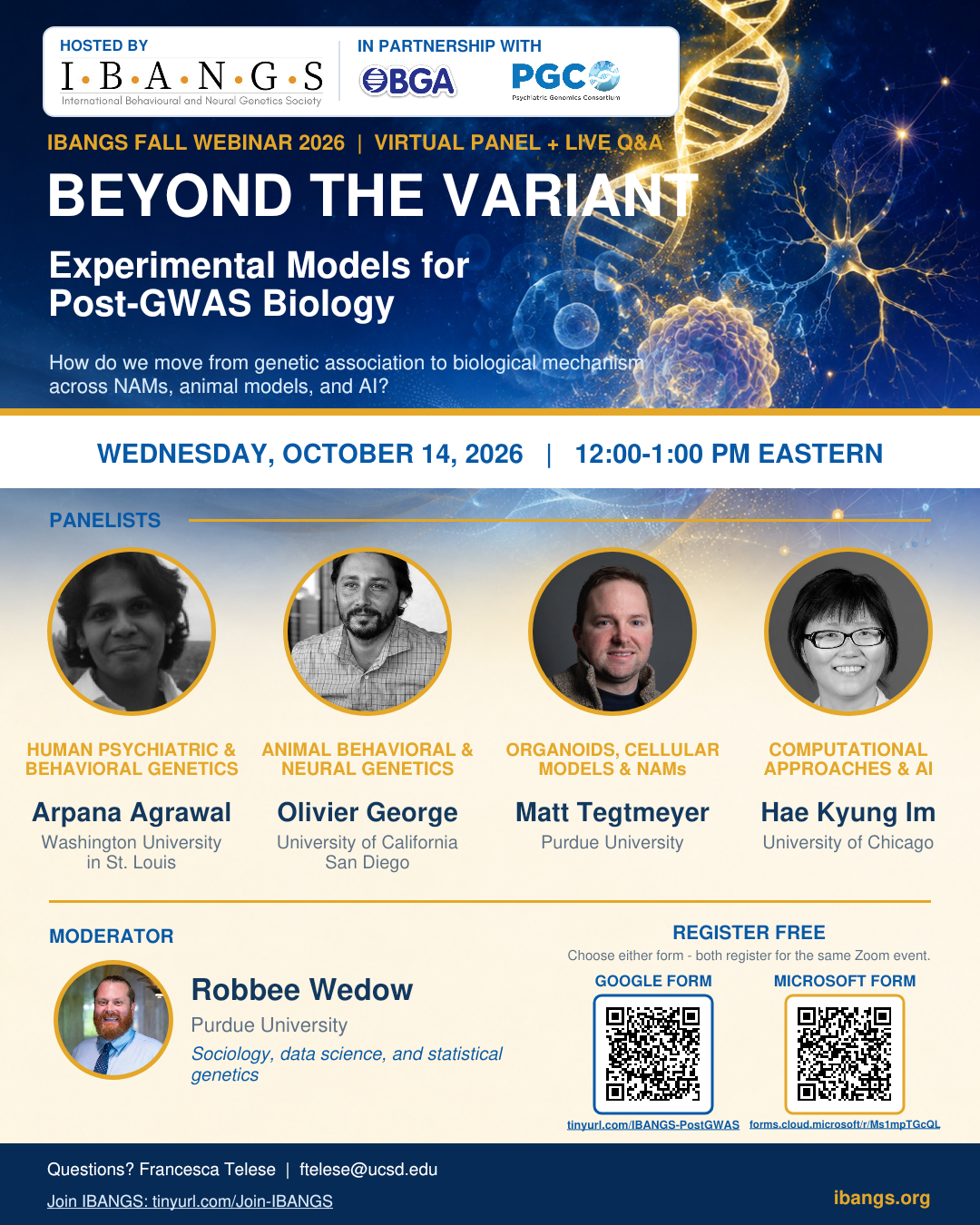
October Seminar
October 14th 12:00-1:00 pm Eastern
Genes, Brain & Behavior 2027
May 24th-27th
Valencia, Spain